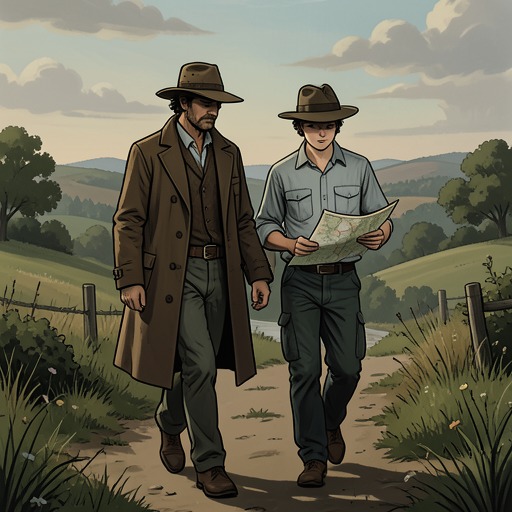
Ben Givens and Emilio (Raul Ramirez)'s Mutual Support
East of the MountainsBen Givens and Emilio become companions not through fluent conversation or shared histories, but through acts of practical kindness that move in both directions. Ben helps Emilio find a meal and a route to harvest work; Emilio, in turn, quietly cares for Ben when illness leaves him weak, then wakes him for a medical emergency. Their relationship is shaped as much by what they do not demand of one another as by what they give.
An encounter made through gestures
Ben first tries to arrange apple-picking work by tracing a route from Wenatchee to Orondo on a map. Emilio cannot understand Ben’s explanation, and the proposed destination does not resolve his immediate isolation: he makes clear that he has no friends there, or where he is now, and calls himself alone. Ben answers that he understands and is alone too. The exchange establishes an affinity without suggesting that the two men have the same circumstances; it gives Ben a point of recognition from which to offer help rather than assume he already knows Emilio’s story.
Their conversation depends on elementary Spanish, gestures, and the map. Ben searches his dictionary for words about hunger and food, then takes Emilio to a restaurant on Wenatchee Avenue. He orders tea for himself and a T-bone steak with fried potatoes for Emilio. Before the steak arrives, Emilio eats a roll and butter; when the plate is set down, he thanks Ben and eats slowly and neatly, using his knife deftly. White scratches mark the backs of his hands, and his fingers are thick and callused. These observed details make his work and hardship visible without supplying a history the scene does not know.
Help without a claim on his story
At the restaurant, Ben learns that the boy is called Emilio, though Emilio offers no surname. Emilio had met two other young men while picking pears near Yakima and traveled north with them because they knew of apple work; by the time Ben meets him, they have gone on and Emilio still needs a job. Ben has an opening to ask about the separation, Emilio’s family, or the journey that brought him so far, but he does not press. He recognizes that limited language is not the only reason Emilio’s past remains undisclosed: a life cannot be reduced to a story extracted over a meal.
Ben also notices that Emilio does not question him about his black eye. This restraint matters to Ben, who is aware that he has secrets of his own. Emilio’s silence is not presented as indifference; it creates a space in which neither has to make a full account of himself before accepting the other’s company. Ben buys Emilio apple pie à la mode and a second glass of milk, then calls the Job Services Office to ask about agricultural work. The gesture joins immediate care to a more durable effort to help Emilio continue on his own terms.
A shared route toward work
The job specialist tells Ben that the remaining agricultural positions are brief because the apple harvest is nearly over. Ben nevertheless secures a referral to Wolfhound Orchard and returns to Emilio with news of work in Malaga. He spreads the map across the table again, traces the route down the west side of the Columbia on the Malaga-Alcoa Highway, and points out where apples can be picked. The map, first used to test a possible destination Emilio does not want, now becomes a practical means of offering him another one.
They set out together. When Ben’s nausea and pain force him to stop on Wenatchee Avenue, he leans against a newspaper vending machine and waits for the feeling to subside. Emilio reaches for the rucksack when Ben does and looks to him for an explanation; Ben thanks him, and Emilio replies in kind. They continue with Emilio hauling both bags while Ben shivers in his coat. At a rental office, the two arrive together in a posture the clerk regards with suspicion, and Ben rents a half-ton Ford. The journey thus includes not only Ben’s referral but Emilio’s physical assistance as Ben struggles to keep moving.
Care in the cabin
At the workers’ camp, Emilio’s support becomes intimate and unmistakably practical. After Ben has collapsed on a cot, he smokes the last marijuana cigarette he has and lies awake amid his pain and fear. Emilio comes to his cabin carrying stove wood, explains that it is very cold, and tends to the room without making a demand of Ben. He places the rucksack on a chair, covers Ben’s legs with a blanket, builds a fire, adjusts the damper, and lights a candle. Ben can offer thanks, but their brief exchange does not require a more elaborate account of what the care means.
Before leaving, Emilio kneels beside the cot. Ben lifts an age-mottled hand and rests it on Emilio’s forearm, thanking him again. Emilio makes the sign of the cross in the air before Ben and says good night. The gesture follows the warmth and shelter he has provided; it does not erase Ben’s illness or fear. Instead, the scene gives their companionship a form that words have not supplied: Emilio attends to Ben’s exposed physical need, and Ben accepts that attention with a touch and gratitude.
Reciprocal responsibility
When Ben dreams of traveling through a barren desert, Emilio’s voice brings him back to the cabin. Emilio repeatedly calls him señor and urgently says that a doctor is needed. The field boss explains that a woman in the camp is in labor and the baby is stuck. Ben agrees to go and tells them to hurry. The moment reveals that Emilio knows Ben as someone who may be able to help, and that he is willing to wake and summon him rather than leave the crisis unattended.
This appeal reverses their earlier roles without cancelling them: Ben had arranged food, a work referral, and shared transport, while Emilio had carried their bags and cared for Ben through a painful night. Now Emilio’s urgency calls Ben back into action, and Ben answers. Their connection remains bounded by limited conversation and the personal histories Emilio has chosen not to disclose. Its importance lies instead in a repeated exchange of attention: each notices a need the other cannot manage alone, and each responds without first requiring a complete explanation.